History
07/23/20260 new articles
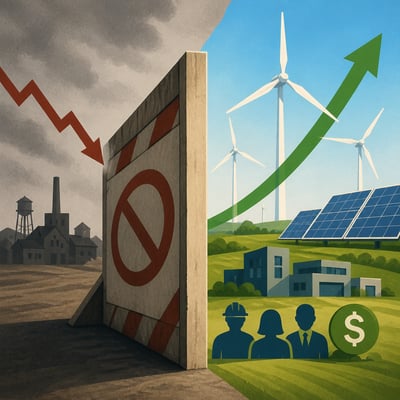
The story is mostly reframed rather than fundamentally changed: the Indiana findings are now described more directly as restrictive ordinances and moratoriums tied to lower GDP and jobs, and the national model adds a new operational implication by saying constrained renewables would require more gas capacity. The overall economic-cost narrative is reinforced, with a slightly sharper emphasis on household electricity bills and system reliability.
07/22/20261 new articles
The story broadened from an Indiana county-level siting issue into a larger economic-policy story about renewable restrictions driving higher power costs nationally. The biggest new element is a modeled U.S. market impact: constrained wind and solar additions could add $121.2 billion in electricity and natural-gas costs from 2027 to 2033.
- NERA Economic Consulting projected $121.2 billion in additional U.S. electricity and natural-gas costs.
- The national model covers 2027 through 2033.
- Constrained renewable additions could require 32 to 38 gigawatts of extra natural-gas capacity.
- ERCOT, NYISO, and Western U.S. markets were newly highlighted as cost-sensitive regions.
- Households, businesses, and electricity consumers were added as affected stakeholders.
05/22/20260 new articles
The current version sharpens the economic findings and adds a clearer policy implication: Indiana’s renewable siting restrictions are now framed as a practical constraint on energy transition planning, not just a local economic tradeoff.
05/11/2026Topic Formed
Recent coverage is tightly aligned around a Purdue-affiliated study for the U.S. Department of Energy finding that county restrictions on wind and solar siting in Indiana are associated with lower local economic output, fewer jobs, and higher tax abatements. The shared signal is a policy-versus-development tension: local limits on renewable projects appear to carry measurable economic costs, especially in rural manufacturing counties, while jurisdictions also compete more aggressively for investment. The topic is coherent, current, and structurally policy-focused, with little fragmentation beyond differences in how the results are framed.

 Climate
 Privacy
 Bob Dylan
 Drones
 Data Centers
 AI Governance
 2026 Maine Senate Race