
Last Update: 06/03/2026 at 6:25 AM EST

Winter Extremes In A Warming Climate

Coverage from Inside Climate News, Yale Climate Connections, and others

Articles

20

Latest Article

05/26

Active Days

121

Executive Summary

Recent coverage shows winter weather becoming more volatile as warming raises atmospheric moisture, shifts snow timing, and complicates storm and avalanche forecasting. The strongest signal is not a disappearance of cold or snow, but a reorganization of winter risk: heavier storms, earlier melt, less reliable snowpack, and more uneven regional outcomes. East Coast snowstorms, Western warmth, and Pacific Northwest mountain hazards recur alongside studies linking warming to precipitation concentration and water-supply stress. Attribution remains mixed for some circulation questions, especially polar vortex behavior, but the broader pattern is coherent and increasingly data-driven.
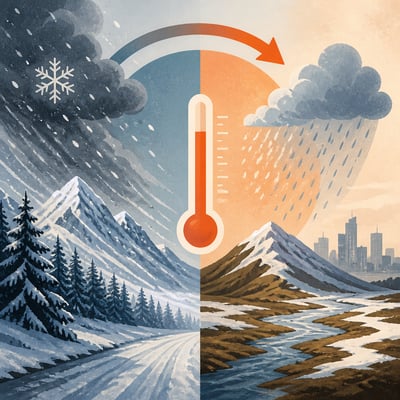
Winter Extremes In A Warming Climate topic image

Key Points

  • Warming is increasing atmospheric moisture, which makes some winter storms heavier even when cold air still arrives.
  • Snow behavior is diverging by region: some places see big snow events, while overall snow cover and snow season length are declining across much of the Northern Hemisphere.
  • Western states face record warmth, reduced snowpack, and earlier runoff that can weaken summer water supplies and raise wildfire risk.
  • The Pacific Northwest and other mountain regions are seeing more rain-on-snow conditions, unstable ice layers, and more complex avalanche forecasting.
  • Winter cold outbreaks still occur, but they are increasingly treated as short-term variability rather than evidence against long-term warming.
  • Circulation explanations such as jet stream waviness and polar vortex disruption remain important but are still uncertain in how strongly they are changing over time.
  • Recent studies extend the topic beyond snowfall into precipitation timing, showing heavier bursts of rain and longer dry gaps can worsen drought and landscape drying.

Featured Article

Ocean State Media03-03-2026
News team reports that northeastern winters have shortened over the past five decades due to warming in the United States.

Coverage Timeline: 121 Days

Jan 26Feb 16Mar 16Apr 6May 4May 25

Additional Articles

⭐⭐⭐⭐⭐

Inside Climate News / Jake Bolster05-13-2026
Nature study published Wednesday links precipitation concentration to drought-driven aridification across hotspots including the Amazon and US West, using datasets and simulations.
Yale Climate Connections / Jeff Masters04-29-2026
Research indicates climate change could slightly increase major-hurricane landfall risk in the U.S. Northeast through storm intensity and track shifts.
Los Angeles Times05-13-2026
Nature researchers report 1980-2022 precipitation clustering in the western United States, linking heavier storms with longer dry spells and Colorado River decline.
Inside Climate News / Jamie Hopkins01-26-2026
On January 26, 2026, Inside Climate News reported how a massive U.S. winter storm tested a downsized FEMA amid climate-driven extreme cold.
The Conversation05-26-2026
U.S. researchers and officials link 2026 drought and heavy-rain flooding risks to warming-driven shifts in precipitation intensity and evaporation, including Massachusetts planning efforts.
Aol05-18-2026
Corey Lesk and Justin Mankin report in Nature that 1980 to 2022 rainfall became more concentrated, risking reduced aquifer and soil water despite stable totals.
BostonGlobe.com02-28-2026
Scientists connect heavy snowfall in Massachusetts and Rhode Island last winter to climate change and warmer ocean temperatures.
USA TODAY / Dinah Voyles Pulver02-07-2026
Climate scientists in the United States and internationally reported in early 2026 that recent Eastern U.S. deep freezes arose from jet stream and polar vortex dynamics while long-term winter temperatures continue to warm.
BBC Science Focus Magazine01-29-2026
AccuWeather meteorologists warn that Arctic warming and sea ice loss helped destabilize the polar vortex, producing a major US winter storm this week across North America.

⭐⭐⭐

Scientific American / Andrea Thompson01-28-2026
Scientists report that a weekend eastern United States winter storm was intensified by warming temperatures and atmospheric moisture, challenging infrastructure planning.
The Guardian03-22-2026
Experts and the National Weather Service report March heat, rare snow, and flooding rains across the United States, linking increased heat likelihood to climate change.
NBC Connecticut / Steve Glazier03-23-2026
Kristina Dahl of Climate Central links Connecticut's 2025-2026 cold blasts and high Hartford snowfall to climate change risk trends while noting jet-stream attribution uncertainty.
AOL / Jennifer Gray03-24-2026
Satellite observations over 43 years indicate Northern Hemisphere snow cover loss and earlier snowmelt, heightening western U.S. water and wildfire risks and accelerating Arctic cryosphere change.
Extreme Temperature Diary- Sunday February 22 / Aristos Georgiou02-22-2026
Northeast US coastal cities brace for a major snowstorm as Nor'easter Hernando intensifies offshore.
climatecentral03-18-2026
Climate Central, using the Climate Shift Index, reported December 2025 through February 2026 daily temperature attribution that increased warmth likelihood in the U.S. West and reduced cold-event likelihood in parts of the East.
KQED / Bejan Siavoshy02-23-2026
Scientists in California this winter report warm conditions and storms, signaling climate driven hazards.
KOIN / Michaela Bourgeois03-27-2026
University of Washington researchers report rain-on-snow warming increases ice-crust avalanches and complicates regional avalanche forecasting across Washington, Idaho, and Montana.
Aspen Daily News / Jacquelyn Francis02-27-2026
Aspen Colorado residents observed winter storms during a recent cold season in the United States, illustrating that warming trends persist despite cold days.

⭐️⭐️

The Allegheny Front / Sophia Schmidt01-26-2026
Philadelphia residents experience heavier snowfall linked to climate change in January 2026.