
Last Update: 06/03/2026 at 5:25 AM EST
Climate-Driven Hail Risk
Coverage from PBS News, Nature, and others
Articles
13
Latest Article
05/31
Active Days
97
Executive Summary
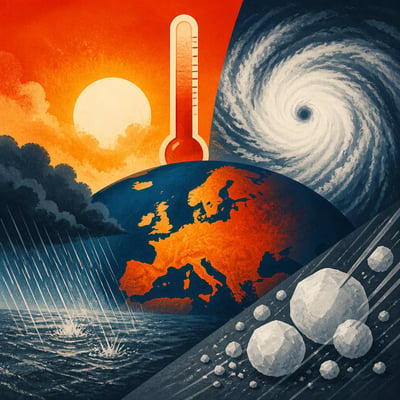
Recent research and attribution reporting consistently link warming to larger, more damaging hail, with higher risks in mid-latitude regions and mixed effects in the tropics. The strongest signal is a shift toward better quantified hail hazard and regional adaptation planning, including insurance and roofing responses.
Key Points
- Multiple studies now connect human-caused warming to larger hailstones and higher damage potential under comparable storm conditions.
- Model results are converging on a regional pattern: hail risk rises more in mid-latitudes, while some tropical and subtropical areas may see less hail reaching the ground.
- The physical mechanism is consistent across the material: warmer air holds more moisture, strengthening updrafts and hail growth, while warmer layers also increase melting.
- Attribution work in Europe suggests current severe hail and rainfall extremes are already more likely or intense in a warmer climate.
- The topic is moving from hazard detection toward practical adaptation, especially improved warnings, hail-resistant roofing, and insurance cost management.
- Colorado is a concrete policy example, with hail losses and premium increases prompting a state-backed roofing grant program.
- Uncertainty remains around local hail behavior because storms are highly small-scale and global models do not resolve hail explicitly.
Featured Article
Researchers studying a May 3 Paris hailstorm reported that human-caused warming increased hail probability and hailstone size in France and Germany.
Coverage Timeline: 97 Days
Hover over any logo to see coverage summary, click for full article.
Additional Articles
⭐⭐⭐⭐⭐
A Nature study projects larger, more damaging hail will increase 38% to 47% by late century due to fossil-fuel-driven warming.
Zhang et al. (Nature, 2026) project end-of-century increases in hailstorm damage potential worldwide, with stronger impacts in mid-latitudes and reductions in tropics and subtropics.
Studies attribute increased Atlantic hurricane intensity to human-caused warming, projecting more Category 4-5 storms and higher damage potential with further warming.
John Allen, Andreas Prein, and Walker Ashley discuss study findings that human-caused warming may increase large hail and widen Europe’s economic losses.
Nature modeling suggests human-caused warming will increase giant hail frequency by 2100, with larger risk increases at higher latitudes in regions such as the United States and Europe.
Gottfried Kirchengast and team unveil a hazard metric for Europe linking extreme heat to human driven climate change during 2010-2024.
World Weather Attribution links increased rainfall intensity to human emissions in Spain, Portugal and Morocco since January.
Researchers from Peking University reported in Nature on April 28 that warming could increase hailstone size and damage in many regions, with varying risk worldwide.
Copernicus data and World Weather Attribution analyses attribute a Europe spring heat dome to human-driven climate change, with risks amplified by Arctic-linked warming feedbacks.
⭐⭐⭐
Colorado lawmakers passed Senate Bill 155 after hail-linked premium increases, aiming to fund hail-proof roofing grants as climate change increases hailstorm risk.
Northern Illinois University climate research in 2024 predicts more golf ball-size hail in a warmer, more unstable atmosphere, including stronger thunderstorm updrafts over Wisconsin.
Victor Gensini of Northern Illinois University reports a record Illinois hailstone after a Tuesday storm near Kankakee.