History
07/25/20260 new articles
Google’s biometric story now centers more concretely on execution: the selfie-video feature is being rolled out to eligible users with specific exclusions, and the company is simultaneously extending biometric likeness use into Google Vids. The framing is less about a general expansion of identity tools and more about a new, operationalized recovery method plus a separate avatar feature that broadens biometric handling.
07/24/20265 new articles
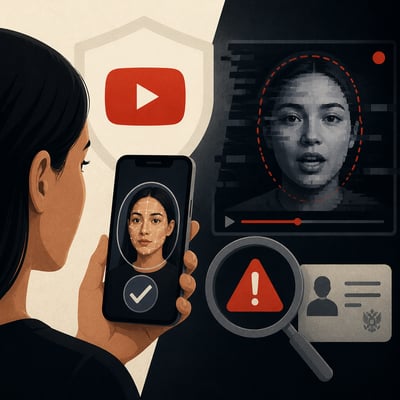
The story has shifted from platform-level deepfake detection to a broader rollout of Google-owned biometric authentication and recovery tools, making face, voice, and ID collection the central issue. YouTube’s likeness detection is now presented as part of a wider identity-protection stack rather than a standalone moderation feature.
- Google is rolling out selfie-video sign-in and recovery.
- Authentication includes guided head movements and liveness checks.
- Reports say biometric recordings can be deleted by users.
- Terms may allow model improvement or secondary use in some settings.
- YouTube now uses selfie video plus government ID for deepfake identification.
07/22/20260 new articles
The story has broadened from platform-specific likeness detection to a wider policy-and-enforcement framework for deepfake abuse. It now emphasizes the emergence of legal protections and the tradeoff between stronger identity verification and expanded biometric data exposure.
07/22/20260 new articles
The story now places more emphasis on execution details and limits of current protections: YouTube’s likeness system is broader but still strongest on faces, while voice detection remains limited. It also adds clearer policy coverage, with U.S. legislation and state law now explicitly part of the response landscape.
07/21/20260 new articles
The story has broadened from platform-side detection and watermarking into a wider ecosystem of misuse and legal response. It now more explicitly centers on commercial fraud and adds concrete legislative action in the U.S. and Italy.
- Commercial deepfakes are being used in scams and payment-related fraud.
- U.S. lawmakers are advancing the NO FAKES Act.
- Tennessee’s ELVIS Act targets unauthorized voice and likeness use.
- Italy’s Law No. 132 adds criminal penalties for harmful AI-altered media.
07/21/20262 new articles
The story broadened from YouTube’s likeness detection rollout into a wider ecosystem of identity-protection tools and legal responses around AI-generated face and voice misuse. The new version adds Google’s watermarking/avatar features, a third-party removal service, and explicit legislative pressure.
- Google Vids added AI avatars and Gemini-powered video editing.
- Generated content will carry SynthID watermarking.
- Loti AI is scanning for unauthorized image and voice use.
- The NO FAKES Act and ELVIS Act enter the story.
- Fake media may spread before takedowns occur.
05/19/2026Topic Formed
YouTube is expanding its likeness detection system to help users find and report AI-generated videos that misuse their face or voice. The tool relies on selfie video and government ID verification, which has drawn privacy concerns even as the platform frames it as a response to rising deepfake impersonation. The broader discussion centers on whether platform-led detection can meaningfully reduce fraud and identity misuse without normalizing biometric data collection.

 Climate
 Privacy
 Bob Dylan
 Drones
 Data Centers
 AI Governance
 2026 Maine Senate Race