
 Climate
 Privacy
 Bob Dylan
 Drones
 Data Centers
 AI Governance
 2026 Maine Senate Race
Rice Faces Climate And Emissions Pressures
Coverage from Food Ingredients First, Illinois News Bureau, and others
Articles
12
Active Days
116
The Topic
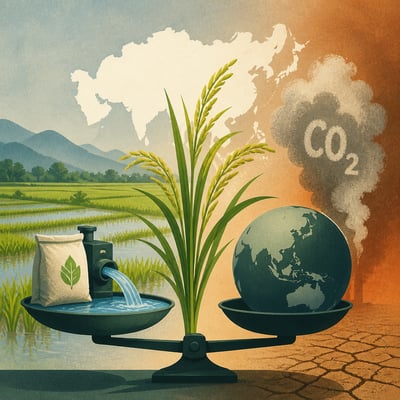
Global rice production has expanded substantially despite climate-related losses, with irrigation, nutrient inputs, multiple cropping, and other management practices helping sustain output. At the same time, warming, heat stress, water shortages, and projected temperature exceedances threaten major Asian rice-growing regions, while intensified and flooded production contributes significant methane and nitrous oxide emissions. Research increasingly points to region-specific water management, optimized inputs, and climate-resilient varieties as ways to protect yields while reducing environmental impacts.
First Article: 03/31/26
Latest Article: 07/24/26
Summary
- Global rice production nearly doubled from the 1960s to the 2010s, largely supported by expanded irrigation, nutrient inputs, and other management practices.
- Climate change reduced estimated global rice production by about 7% between 2006 and 2015 through warming, heat stress, and water shortages.
- India experienced the largest reported climate-related rice losses, followed by Indonesia and China.
- Projected warming could expand Asian rice-growing areas exposed to critical temperature thresholds by 10 to 30 times by the end of the century.
- Rice paddies emitted about 1.1 billion tons of carbon dioxide equivalent annually in the 2010s, with emissions rising through land expansion and intensified management.
- Intermittent irrigation, reduced excess fertilizer and residue inputs, and improved tillage practices could lower emissions without necessarily reducing yields, but results vary by region.
- Plant breeding and selection of rice varieties with greater heat and drought tolerance are being pursued alongside reduced-water production methods.
History
The story now puts more weight on mitigation details and broader adaptation, adding that rice emissions are tied to intensified management and that improved tillage and region-specific practices can reduce impacts. It also sharpens the Asia temperature-risk claim and adds India as the most affected country.
The story has become more quantified and more climate-risk-focused: it now puts a concrete estimate on both past climate-driven rice losses and future temperature exposure, while also sharpening the emissions tradeoffs of adaptation. The framing shifts from general tension between climate and rice output to a more explicit policy problem of balancing yield protection with water, pollution, and methane reductions.
Featured
Timeline: 116 Days
Hover over any logo to see coverage summary, click for full article.