History
07/23/20260 new articles
The story has broadened from general climate-disease risk to a more specific preparedness frame, with renewed attention to hantavirus in Argentina and Africa and clearer emphasis on cross-sector response needs. It also adds a more explicit call for attribution research, diagnostics, and rapid-response planning before transmission becomes established in new places.
07/22/20261 new articles
The story now centers more explicitly on modeled, region-specific shifts in climate-sensitive disease risk, adding new pathogens and a broader preparedness framework. It moves beyond general climate-disease attribution toward concrete projections for chikungunya, hantavirus, and influenza under changing temperature and rainfall patterns.
- Chikungunya risk is projected to expand into parts of Europe, northeastern North America, and East Asia.
- Influenza transmission may weaken in some colder regions and intensify in some tropical regions.
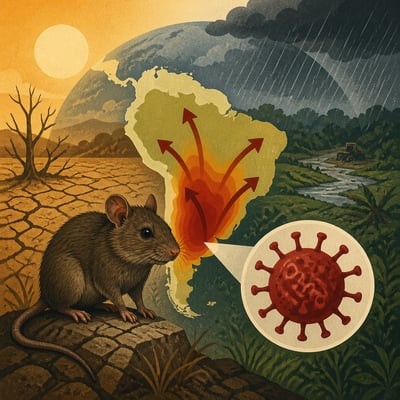
- Drought followed by heavy rainfall may influence hantavirus exposure and rodent populations.
- Scientists are calling for cross-border data sharing and stronger detection systems.
- The current reporting is based on 2026 publications and projections extending to 2100.
06/29/20260 new articles
The story has broadened from climate-linked disease risk patterns to a more explicit focus on attribution science—how much disease burden can actually be tied to climate change. It also sharpens the framing around spillover, emphasizing habitat loss, defaunation, and human encroachment as key amplifiers of wildlife contact.
06/16/20263 new articles
The story has broadened from a mainly hantavirus and Valley Fever framing into a wider climate-health risk picture that now prominently includes chikungunya and other vector-borne diseases. The newest material also strengthens the preparedness angle, emphasizing surveillance, attribution, and One Health coordination as central responses.
- Chikungunya suitability is now a prominent modeled risk.
- Vector-borne disease risk is newly emphasized alongside rodent-borne and fungal disease.
- Land-use change is added as a climate-related driver of spillover risk.
- Surveillance, attribution, and One Health coordination are now central preparedness themes.
05/24/20263 new articles
The story has broadened from a hantavirus-centered climate-risk narrative into a wider infectious-disease framing that now includes Valley Fever and more explicit climate attribution and preparedness themes. It also places greater emphasis on regional expansion of arenavirus risk into non-endemic areas by mid-century.
- Valley Fever now features as a major climate-sensitive disease thread.
- Modeling projects arenavirus risk expanding into currently non-endemic areas by mid-century.
- Climate-disease reports now emphasize surveillance and One Health preparedness.
- The geographic frame now includes the U.S. Southwest, Europe, and Africa.
05/19/20264 new articles
The story has become broader and more concrete: besides Argentina’s hantavirus surge, it now includes the MV Hondius outbreak and formal modeling/reporting that extends concern across South America. At the same time, the framing is more cautious, emphasizing uncertainty in attributing specific outbreaks directly to climate change while highlighting surveillance gaps and preparedness limits.
05/15/2026Topic Formed
This topic centers on evidence that climate change may alter where rodent-borne viruses spread, especially in South America. The strongest current thread is a mix of outbreak reporting from Argentina and modeling studies projecting future expansion of New World arenavirus risk into areas with little prior exposure. Across the material, drought, heavy rainfall, land-use change, and shifting rodent habitat appear as the main mechanisms linking climate variability to human infection risk. The public-health significance is increased surveillance and preparedness in places that may become newly exposed.

 Climate
 Privacy
 Bob Dylan
 Drones
 Data Centers
 AI Governance
 2026 Maine Senate Race