
Last Update: 06/03/2026 at 4:25 PM EST
Climate-Linked Malaria And Mosquito Disease Risk
Coverage from Nature, Met Office, and others
Articles
9
Latest Article
05/14
Active Days
134
Executive Summary
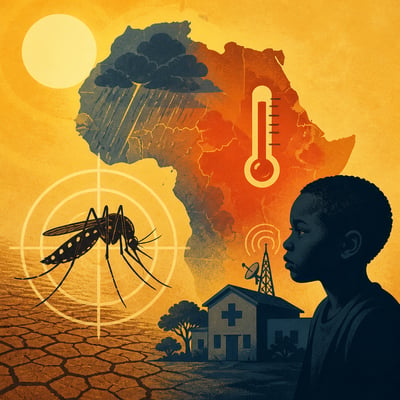
Recent coverage shows climate change affecting mosquito-borne disease mainly through extreme weather, flooding, and system disruption rather than temperature alone. The strongest evidence concerns malaria in Africa, where studies project major increases in cases and deaths unless control systems become more climate-resilient. A smaller set of reports extends the same risk logic to dengue and heat exposure, including local transmission in the United States and projected heat stress across parts of Africa.
Key Points
- The dominant signal is malaria risk in Africa, where multiple studies project that extreme weather disruptions will drive most of the additional burden by 2050.
- Evidence consistently distinguishes ecological warming effects from operational disruption: flooding, storms, and infrastructure damage weaken bed nets, diagnostics, treatment, and surveillance.
- Several African country reports describe the same adaptation gap: surveillance and early warning are improving in concept, but technical capacity, funding, and cross-sector coordination remain limited.
- The topic is not limited to long-term projections; real-world climate-sensitive outbreaks are also being linked to recent events, including dengue transmission in Peru and Los Angeles County.
- Heat risk appears as a parallel climate-health pressure, with one study projecting very long heatwave exposure across parts of Africa by late century and land-use change intensifying the hazard.
- The evidence base is moderately dense and fairly coherent, but it spans different diseases, regions, and timescales, so the cluster is thematically unified rather than narrowly focused.
- Current framing is shifting from broad climate-disease association toward implementation questions: where control systems fail, which regions are most exposed, and what operational adaptations reduce risk.
Featured Article
Researchers warn that extreme weather linked to climate change will drive malaria cases and deaths across Africa by 2050.
Coverage Timeline: 134 Days
Hover over any logo to see coverage summary, click for full article.
Additional Articles
⭐⭐⭐⭐⭐⭐⭐⭐
Researchers project malaria cases and deaths rise through 2050 due to extreme weather disruptions to health systems in Africa.
⭐⭐⭐⭐⭐
Researchers warn that climate variability and extreme weather threaten malaria control in Africa in the near term.
Malaria control programmes in Chad, Côte d'Ivoire, the Democratic Republic of the Congo, Madagascar, Rwanda, and Senegal report climate-driven changes to rainfall, flooding, and transmission seasons.
Hydroclimate scientists project many African regions will experience near-permanent heatwaves by 2065-2100, driven by global emissions and local land-use change across West, East and Southern Africa.
Researchers in Peru and the United States report climate-linked warmer, wetter conditions increased dengue epidemic risk after a 2023 cyclone and El Nino.
CDC Emerging Infectious Diseases documented a seven-week dengue transmission chain in Los Angeles County in fall 2024 as climate-driven mosquito suitability enabled local spread from traveler introductions.
Researchers warn that climate driven disruptions in Africa could raise malaria cases and deaths by mid century.
⭐⭐⭐
A historical account links UK malaria outbreaks to mosquito ecology and Plasmodium temperature needs, suggesting warming could change vector-borne risk by region.