
Last Update: 08/01/2026 at 8:33 PM EST

Coral Reefs Face Repeated Bleaching

Coverage from The Guardian, CBS News, and others

Articles

20

Active Days

285

The Topic
Coral Reefs Face Repeated Bleaching topic image

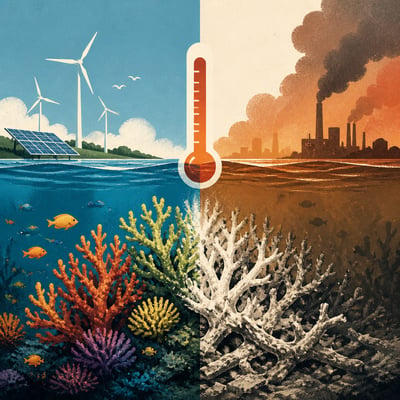
Coral reefs are facing increasingly frequent and widespread bleaching as warmer oceans and a possible return of El Niño add to persistent heat stress. At the same time, research has identified nearly 166,000 square kilometers of reefs across 71 countries that may be better able to withstand or recover from climate impacts, although most are outside protected areas. The findings shift attention toward prioritizing resilient reefs for conservation while recognizing that resilience does not remove the broader threat from continued warming.

First Article: 10/12/25

Latest Article: 07/23/26

Summary

  • NOAA projects high bleaching risk across parts of the northern Pacific, Hawaii, Florida and the Caribbean if El Niño develops.
  • The previous global bleaching event affected about 84% of the world’s reef area and ended in 2025.
  • A study mapped roughly 165,922 square kilometers of potentially climate-resilient reefs across 71 countries and 100 jurisdictions.
  • Only about 28% of the mapped resilient reef area is currently within protected or conserved areas.
  • The resilience assessment combines more than 45,000 coral surveys with climate, ocean and human-pressure data.
  • Researchers continue to debate how much reef resilience can offset repeated heat stress and long-term warming.

History

07/22/2026

The story is largely confirmed rather than transformed: the main update is a reframing of the reef-resilience research and the bleaching outlook, with clearer emphasis on conservation prioritization and the broader vulnerability of most reefs. The current version also broadens the human and ecological context slightly, but it does not introduce a materially new event.

07/22/2026

The story is largely the same, but the framing has sharpened: the bleaching threat is now tied to the coming months of 2026 and described as recurring climate stress after the 2024–2025 episode. The resilience research also adds that the mapped refuge reefs are unevenly protected and confidence varies by region, reinforcing the need for targeted conservation.

Full History

Featured

Timeline: 285 Days

2025Jan 1Mar 5May 28Jul 30Oct 22Dec 242026Jan 1Mar 5May 28Jul 30Oct 22Dec 24

Additional Articles

⭐⭐⭐⭐⭐⭐⭐⭐

Mongabay / Rhett Butler02-18-2026
Researchers analyzing global reef surveys report that marine heatwaves from 2014 to 2017 caused unprecedented, widespread coral bleaching and mortality across tropical oceans worldwide.

⭐⭐⭐⭐⭐

Conservation news / Shreya Dasgupta06-25-2026
Wildlife Conservation Society and Macquarie University researchers presented an AI-based study in Mombasa, Kenya, estimating one-third of coral reef area may be climate-resilient by 2050 under high emissions.
Cyprus Mail06-20-2026
Wildlife Conservation Society researchers identified nearly 166,000 sq km of climate-resilient coral reefs across 71 countries using 45,000 surveys and decades of climate data.
AOL / Emily Mae Czachor06-03-2026
NOAA forecast high coral bleaching risk for northern Pacific reefs this summer, with additional threats to Florida and Caribbean reefs, driven by an expected El Niño.
PR Newswire07-23-2026
Oceanography research attributes nearly all global coral bleaching events over 40 years to human-driven ocean warming, projecting broad bleaching during 2026-2027 El Niño.
Smithsonian Magazine / Sara Hashemi06-22-2026
Researchers use AI to map coral reef climate refugia across countries and territories, presenting June 16 results at the Our Ocean Conference in Mombasa, Kenya.
ScienceDaily10-29-2025
Scientists led by Wunderling and Lenton warn that climate tipping points could trigger cascading changes, ahead of the 2025 World Climate Conference in Belém, Brazil.
Science News Explores / Lillian Steenblik Hwang12-11-2025
More than 200 scientists report in Global Tipping Points Report 2025 that current warming has already triggered irreversible coral reef collapse worldwide, announced ahead of the 2025 UN Climate Change Conference near the Amazon.

⭐⭐⭐

The Guardian10-12-2025
Researchers warn that warm water coral reefs face tipping point due to greenhouse gas emissions, with current warming near 1.4C and reefs affected in over 80 countries since January 2023.
Qatar Tribune06-21-2026
WCS and Macquarie University mapped climate-resilient coral reefs through 2050 using 45,000 surveys and 42 indicators to support conservation planning.
Ocean Acidification03-16-2026
Researchers study reef fish across cool, warm, and extreme reef sites during marine heatwaves to assess climate driven gut microbiome changes.
Weather / Ada Wood05-22-2026
Ocean warming is linked to more frequent coral bleaching events, heightening biodiversity and coastal protection risks while restoration efforts focus on resilient corals.
Time / Simmone Shah10-12-2025
The University of Exeter reports warm-water coral reefs have passed a global thermal tipping point, researchers warn of heightened risks for Amazon dieback and AMOC disruption.
USA TODAY / scientists in Europe10-13-2025
European scientists released the Global Tipping Points Report Oct. 13, 2025, finding warm-water coral reefs worldwide have passed a climate-driven tipping point.
SciTechDaily10-15-2025
Researchers releasing the Global Tipping Points Report 2025 on October 13, 2025, warn coral reefs have tipped and polar ice sheets face likely irreversible melt, global.
CICERO10-13-2025
University of Exeter-led Global Tipping Points Report 2025 warns on 13 October that coral tipping, polar ice instability and AMOC risk rise if warming overshoots 1.5C.
The Ecologist / Professor Tim Lenton10-13-2025
Global scientists report warm-water coral reefs have passed a thermal tipping point and warn of imminent risks to ice sheets, Amazon and AMOC as temperatures near 1.5C.