History
07/22/20260 new articles
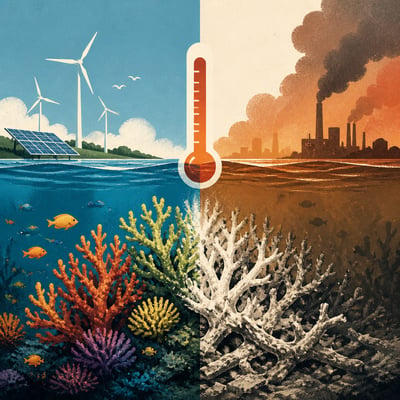
The story is largely confirmed rather than transformed: the main update is a reframing of the reef-resilience research and the bleaching outlook, with clearer emphasis on conservation prioritization and the broader vulnerability of most reefs. The current version also broadens the human and ecological context slightly, but it does not introduce a materially new event.
07/22/20260 new articles
The story is largely the same, but the framing has sharpened: the bleaching threat is now tied to the coming months of 2026 and described as recurring climate stress after the 2024–2025 episode. The resilience research also adds that the mapped refuge reefs are unevenly protected and confidence varies by region, reinforcing the need for targeted conservation.
07/22/20260 new articles
The story has become more concrete and quantified: NOAA’s bleaching warning is now paired with a specific outlook for 2026, while the resilience research now maps a large, multi-country set of potentially survivable reefs. The focus has shifted from general concern about reef tipping points to prioritizing where protection and funding could still preserve reef function.
- NOAA now highlights 2026 bleaching risk if El Niño develops.
- About 165,922 square kilometers of reefs may be climate-resilient.
- Fewer than 28% of resilient reefs are inside protected areas.
- The analysis uses more than 45,000 coral surveys.
- The 2023–2025 bleaching event affected about 84% of reef area.
06/29/20262 new articles
The story now emphasizes a broader, more concrete climate-stress picture for reefs, adding acidification and repeated marine heatwaves as key drivers while keeping the tipping-point framing intact. It also strengthens the conservation angle by highlighting a separate resilience effort aimed at identifying refuge reefs that may still be worth protecting and restoring.
06/22/20263 new articles
The story has shifted from a general warning that coral reefs have crossed a tipping point to a more developed frame that combines near-term heat risk with actionable conservation triage. The new emphasis is on identifying reef refuges that may still hold resilience through mid-century, rather than treating all reefs as uniformly lost.
- Threshold now framed near 1.2C to 1.5C warming.
- Studies map reef refuges resilient through mid-century.
- Most resilient reefs remain outside protected areas.
- NOAA warns of renewed El Niño bleaching risk in the northern Pacific.
- Wildlife Conservation Society and Macquarie University join the story.
06/05/20263 new articles
The core reef-tipping-point narrative is unchanged, but the current version sharpens the near-term bleaching threat by bringing in NOAA monitoring and El Niño as explicit drivers. It also narrows the story’s focus away from the broader set of climate tipping elements and toward immediate reef-risk outlooks, especially for summer 2026.
05/21/20260 new articles
The story is largely stable, but the framing has sharpened: reef tipping is now described more explicitly as already crossed, with added emphasis on 1.5 C overshoot and concrete impact channels. The positive-tipping thread has also broadened from a general mitigation example to stronger attention on rapid solar and EV adoption dynamics.
05/11/2026Topic Formed
Recent scientific reporting converges on warm-water coral reefs as the clearest current climate tipping point, with widespread bleaching and dieback tied to marine heatwaves and warming near 1.5 C. The same assessments warn that the Amazon, polar ice sheets, and Atlantic circulation remain vulnerable to further nonlinear shifts if warming continues, while renewables and electric vehicles are still cited as the main positive tipping examples.

 Climate
 Privacy
 Bob Dylan
 Drones
 Data Centers
 AI Governance
 2026 Maine Senate Race