
 Climate
 Privacy
 Bob Dylan
 Drones
 Data Centers
 AI Governance
 2026 Maine Senate Race
Forest Carbon Storage Under Heat Stress
Coverage from The Guardian, Cornell Chronicle, and others
Articles
8
Active Days
42
The Topic
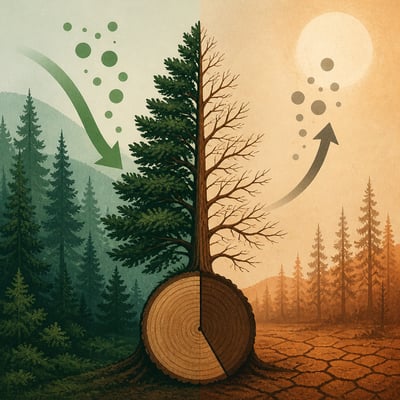
Recent research converges on a similar finding: forests keep absorbing carbon even after growth slows or stops, but heat and drought reduce how much of that carbon becomes lasting wood storage. Multiple studies also suggest common land and Earth system models may overestimate future forest carbon sinks because they do not fully capture growth limits under hotter, drier conditions. A second line of evidence finds that CO2-related vegetation water-saving benefits are partly offset by atmospheric feedbacks, weakening expectations that plant physiology alone will ease drought stress. The topic is coherent and research-heavy, with moderate-to-dense signal and a mostly ongoing, structural frame rather than a short-lived event.
First Article: 06/13/26
Latest Article: 07/24/26
Summary
- Across US and Swiss forest studies, photosynthesis often continues after annual wood growth has slowed or stopped.
- Heat and drought repeatedly appear as the main constraints on turning absorbed carbon into durable biomass.
- Several studies argue that land and Earth system models may overestimate future forest carbon storage if they assume tight coupling between photosynthesis and growth.
- One modeling result suggests forest carbon storage capacity could be overstated by as much as 30% in hotter, drier conditions.
- A separate modeling study finds CO2-driven vegetation water savings are partly offset by atmospheric feedbacks, reducing their drought-relief value.
- The evidence points to weaker forest carbon sink strength under warming, but the exact size of the bias remains uncertain across regions and species.
- The cluster is stable and internally coherent, with multiple studies reinforcing the same physiological and modeling mismatch.
History
The story has broadened from a single forest-growth decoupling study into a larger body of June–July 2026 research showing the same mismatch across regions and models. The new emphasis is not just that forests may store less carbon than assumed, but that both land-surface and atmospheric-feedback models may systematically overstate future carbon-sink benefits under warming and drought.
Featured
Timeline: 42 Days
Hover over any logo to see coverage summary, click for full article.