History
07/23/20260 new articles
The story now emphasizes a broader, more concrete regional flood event with added damage and response details, including evacuations and emergency declarations. It also sharpens the framing around incomplete flood maps and the need for resilience investment, while dropping some earlier emphasis on insurance access and dam-failure history.
07/22/20262 new articles
The story has broadened from general flood and infrastructure stress in Michigan and Wisconsin to a sharper focus on spring 2026 flooding exposing gaps in flood mapping, flood insurance access, and water-management capacity. It now also emphasizes specific resilience responses and renewed concern over prior dam failures.
- Spring 2026 flooding was worsened by record snow followed by heavy rain.
- Rural properties are missing from FEMA flood maps or use incomplete assessment methods.
- Some residents near lakes and waterways struggled to obtain flood insurance.
- Officials are considering dedicated stormwater funding for resilience upgrades.
- Prior Edenville and Sanford dam failures are being revisited as context.
05/30/20261 new articles
The story is now framed more directly around recurring flood and storm damage exposing the limits of aging infrastructure, with FEMA and local recovery impacts becoming more explicit. The broader climate signal remains the same, but the emphasis has shifted from general warming-driven risk to immediate community and infrastructure consequences.
05/12/2026Topic Formed
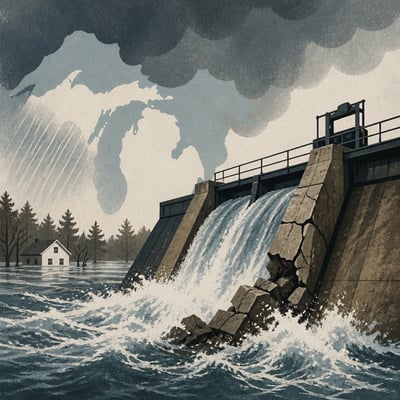
Recent reporting shows warmer, wetter conditions across Wisconsin and Michigan are increasing heavy rainfall, rain-on-snow flooding, and pressure on aging dams, stormwater systems, and shoreline infrastructure. The signal is cohesive and current, with adaptation needs becoming more visible than mitigation debate in this slice.

 Climate
 Privacy
 Bob Dylan
 Drones
 Data Centers
 AI Governance
 2026 Maine Senate Race