
 Climate
 Privacy
 Bob Dylan
 Drones
 Data Centers
 AI Governance
 2026 Maine Senate Race
Integrated Farming For Drought Resilience
Coverage from Grist, Frontiers, and others
Articles
5
Active Days
103
The Topic
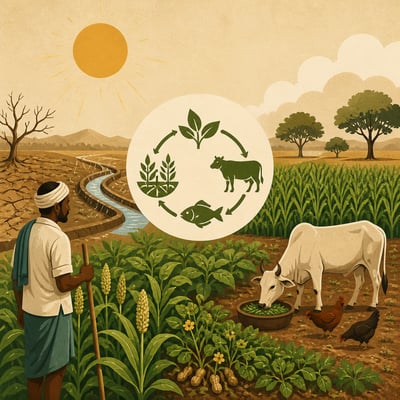
The material centers on integrated farming as a practical adaptation approach for drought-prone agriculture in Southern India, with emphasis on rainfed and partially irrigated smallholder systems. Evidence points to gains from diversified cropping, intercropping, conservation furrows, improved fodder, and livestock inputs, alongside broader government efforts to scale climate-resilient practices. The topic also sits within a wider policy and research push to reduce vulnerability from climate variability and crop failure.
First Article: 03/26/26
Latest Article: 07/06/26
Summary
- The core focus is adaptation in frequently drought-prone, rainfed farming systems in Southern India.
- Field-based interventions combined diversified cropping, drought-tolerant varieties, intercropping, conservation furrows, and improved livestock support.
- Reported outcomes include higher system productivity and stronger drought-year performance compared with usual farmer practices.
- The evidence base is still largely practical and context-specific, with an emphasis on small and marginal farmers facing low yields and livelihood stress.
- Broader Indian climate-resilience programs reinforce the same direction through contingency planning, seed systems, resilient varieties, micro-irrigation, and insurance.
- The topic is linked to a wider debate about how far integrated or traditional farming approaches can be scaled across vulnerable regions.
History
This topic is new, but as new articles are added to it this area will summarize shifts, changes and expansions of the issues.
Featured
Timeline: 103 Days
Hover over any logo to see coverage summary, click for full article.