
 Climate
 Privacy
 Bob Dylan
 Drones
 Data Centers
 AI Governance
 2026 Maine Senate Race
Soil Restoration for Climate Resilience
Coverage from 8am.media, Frontiers, and others
Articles
6
Active Days
103
The Topic
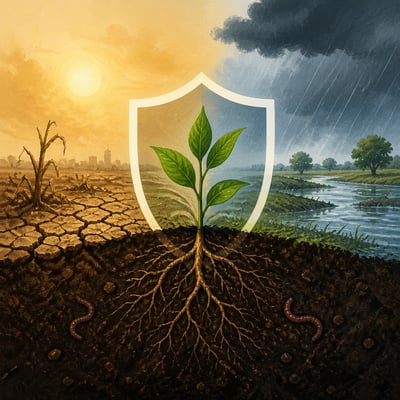
Climate change, land clearing, intensive farming, deforestation, and weak land management are degrading soils and reducing their ability to support crops, retain water, and store carbon. The effects are especially acute in vulnerable agricultural regions, including Afghanistan and rain-fed farming areas, where erosion, drought, floods, and irregular rainfall threaten food security. The material increasingly frames soil restoration, regenerative agriculture, and integrated soil-security policies as practical adaptation measures, while noting that implementation requires public investment and support for farmers.
First Article: 03/24/26
Latest Article: 07/04/26
Summary
- Climate stress and land misuse are accelerating erosion, fertility loss, and declining water retention.
- Afghanistan faces extensive soil erosion, with experts linking the problem to reduced vegetation, deforestation, floods, droughts, and dust storms.
- Degraded soils can reduce crop yields and increase exposure to both drought and flooding, putting food systems under pressure.
- Soil loss also weakens natural carbon storage and can contribute to greenhouse-gas emissions and nutrient runoff.
- Regenerative agriculture, agroforestry, cover crops, diversified rotations, and pasture restoration are repeatedly presented as restoration measures.
- A soil-security framework broadens assessment beyond physical conditions to include social, economic, institutional, and policy factors.
- Smallholders and rural, Indigenous, and Tribal communities face disproportionate exposure while often lacking access to land, capital, and climate finance.
History
The story is reframed from general soil degradation and restoration to a more explicit soil-security agenda that broadens the problem beyond physical land condition to institutional, social, and finance constraints. It also adds stronger emphasis on vulnerable communities’ access gaps and on floods, droughts, and dust storms as part of Afghanistan’s worsening erosion picture.
The story is now framed more explicitly as an implementation problem: soil restoration is still the answer, but the current version adds that it needs investment, policy support, and transition help for farmers. It also sharpens the Afghanistan angle by tying erosion more directly to vegetation loss, deforestation, and irregular rainfall.
Featured
Timeline: 103 Days
Hover over any logo to see coverage summary, click for full article.