History
07/23/20260 new articles
The story shifts from a broad reef-connectivity warning to a more specific Pacific framing that quantifies impacts and emphasizes management of connected shallow-and-deep reef networks. The biggest new point is that adding pH and oxygen to models materially increases projected cold-water coral impacts.
07/22/20260 new articles
The story now puts much more emphasis on specific reef-network nodes and refugia that shape recovery, rather than just broad stressor interactions. It also extends the evidence base more explicitly from shallow reefs to deep-water and cold-water corals, strengthening the case for connectivity-based protection across multiple habitats.
- Coral Sea reefs are identified as larval hubs connecting major southwestern Pacific reef systems.
- Lord Howe Island may act as a relatively climate-resilient coral refuge.
- Cold-water coral models now include pH and dissolved oxygen effects.
- Galápagos deep-water coral sensitivity is linked to circulation-driven oxygen changes.
- Protection planning now emphasizes cross-jurisdiction marine connectivity.
05/30/20260 new articles
The story is slightly more focused on climate stress interactions, with the biggest update being a clearer emphasis on pH and dissolved oxygen as essential variables for coral risk and resilience estimates. The framing also broadens modestly from coral decline to protection and adaptation planning.
05/12/2026Topic Formed
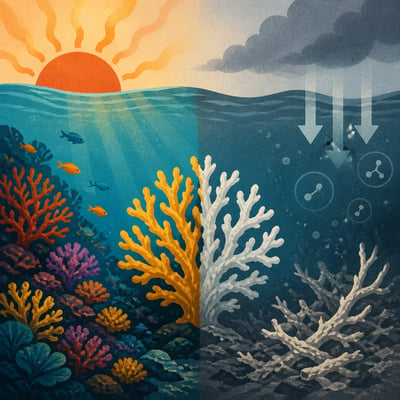
Recent research links ocean warming, acidification, deoxygenation, and circulation changes to coral decline, showing that biodiversity loss and range contraction are likely worse when models include oxygen and pH. The material also emphasizes reef connectivity, refugia, and protected-area design as key responses.

 Climate
 Privacy
 Bob Dylan
 Drones
 Data Centers
 AI Governance
 2026 Maine Senate Race