
Last Update: 08/01/2026 at 2:00 PM EST

Ships Add Onboard Carbon Capture

Coverage from Nature, ScienceDirect, and others

Articles

19

Active Days

356

The Topic
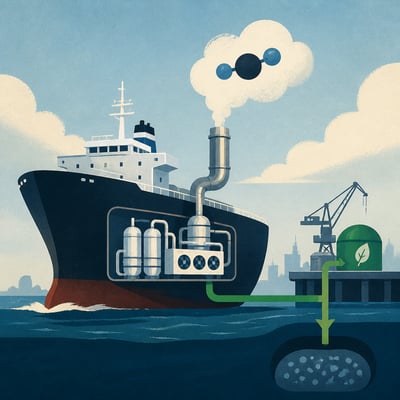
Ships Add Onboard Carbon Capture topic image

Onboard carbon capture and storage is being developed as a possible emissions-reduction option for ships that remain dependent on fossil or transition fuels. Studies indicate that performance depends heavily on vessel design, engine conditions, capture technology, methane emissions, available space, and arrangements for storing and offloading captured CO2. DNV has introduced a common verification framework, but wider adoption still depends on vessel integration, carbon-reception infrastructure, and regulatory recognition.

First Article: 09/11/25

Latest Article: 09/01/26

Summary

  • LNG carriers and large tankers appear best suited for early onboard carbon capture because they generally offer more space and favorable operating and energy characteristics.
  • Onboard systems can reduce lifecycle greenhouse-gas emissions, but reported benefits vary substantially with vessel operations, system design, methane slip, and fuel-supply emissions.
  • Cryogenic and solvent-based systems show strong performance under suitable conditions, while off-design engine operation can sharply reduce capture efficiency or increase energy use.
  • Shore-based solvent regeneration may improve the economics and practicality of maritime capture by reducing onboard energy and space requirements.
  • DNV-RP-0698 establishes harmonized metrics and third-party verification procedures for measuring onboard capture performance across newbuild and retrofit projects.
  • Commercial rollout remains route-specific and pilot-led because captured CO2 must be stored, transported, and received at ports, while IMO crediting rules remain incomplete.

History

07/24/2026

The story has shifted away from regulatory pathway-building toward a more operationally grounded assessment of where onboard carbon capture works best and why. The new version adds clearer vessel-segment prioritization and specific technical factors that determine whether the technology is practical.

07/23/2026

The story has shifted from technical feasibility to regulatory pathway-building, with EU and IMO signals now making onboard carbon capture look more deployable for compliance use on fossil- and transitional-fuel ships. Standardization is also becoming more concrete around DNV's verification framework, while port access, storage, and traceability remain the main blockers.

Full History

Featured

Timeline: 356 Days

2025Jan 1Mar 5May 28Jul 30Oct 22Dec 242026Jan 1Mar 5May 28Jul 30Oct 22Dec 24

Additional Articles

⭐⭐⭐⭐⭐

Splash24706-22-2026
DNV issued DNV-RP-0698 in support of standardized measurement and verification of onboard carbon capture and storage systems for shipping, with IMO guidelines targeting completion in 2028.
Ship & Bunker06-10-2026
A Lloyd's Register Advisory study for the International Chamber of Shipping concludes onboard CO2 capture and storage is feasible for LNG carriers and tankers but requires infrastructure and IMO crediting rules.
Splash247 / Sam Chambers06-10-2026
International Chamber of Shipping backed onboard carbon capture and storage in a 146-page report in 2020s timeframe, citing IMO tightening and limited green fuel availability for maritime compliance.
The Maritime Executive06-17-2026
IMO MEPC 83 approved an OCCS work plan in April 2025 as shipping OCCS development remains constrained by CO2 terminal access, carbon accounting traceability, and economics versus EU ETS.
gCaptain / Paul Morgan07-01-2026
Lloyd's Register Advisory and the International Chamber of Shipping assess onboard carbon capture for ships, citing port infrastructure and regulation as key bottlenecks.

⭐⭐⭐

Ship & Bunker07-22-2026
GCMD reported EU ETS recognition and IMO in-principle support for Project CAPTURED to treat onboard captured CO2 via carbon mineralisation as permanent storage.
Maritime Logistics Professional06-22-2026
IMO is developing OCCS guidelines by 2028 while DNV-RP-0698 standardizes onboard carbon capture performance metrics and third-party verification for shipping.
The Maritime Executive07-21-2026
GCMD secured EU ETS approval in 2025 tests aboard Ever Top for onboard CO2 mineralization into calcium carbonate as an eligible permanent-storage pathway.
SAFETY4SEA07-22-2026
Project CAPTURED reported EU ETS recognition and IMO in-principle support for permanent onboard CO2 storage via carbon mineralization after a June 2025 maritime demonstration.
Splash24707-22-2026
Global Centre for Maritime Decarbonisation completed a June 2025 pilot for onboard captured CO2 mineralisation, enabling EU ETS deduction and in-principle IMO MEPC 84 support for permanence.
Carbon Capture Journal06-22-2026
DNV published DNV-RP-0698 to standardize measurement and verification of onboard carbon capture and storage performance for ships as IMO OCCS guidelines advance toward 2028.
ICS Shipping06-12-2026
Lloyd's Register Advisory, commissioned by the International Chamber of Shipping, reports onboard carbon capture and storage is feasible for shipping, with adoption tied to integration, disposal infrastructure, and regulatory certainty.
Marine Log / Marine Log Staff03-06-2026
Industry stakeholders describe onboard carbon capture as a transitional decarbonization option for ships during the 2020s amid evolving regulation and port infrastructure.
SAFETY4SEA03-24-2026
China urged the IMO Marine Environment Protection Committee at its 84th session in 2020s timelines to accelerate onboard OCCS shipping regulation, targeting 2026 initial guidelines and 2028 completion.
SAFETY4SEA / The Editorial Team03-24-2026
China urged the IMO Marine Environment Protection Committee on OCCS shipping regulation, proposing initial guidelines in 2026 and completion by 2028 with phased, streamlined reporting-verification.

⭐️⭐️

09-11-2025
IMO organized a seminar on onboard carbon capture and storage in London on 11 September 2025 to advance regulatory frameworks for OCCS in shipping.