History
07/24/20260 new articles
The story has shifted away from regulatory pathway-building toward a more operationally grounded assessment of where onboard carbon capture works best and why. The new version adds clearer vessel-segment prioritization and specific technical factors that determine whether the technology is practical.
07/23/20264 new articles
The story has shifted from technical feasibility to regulatory pathway-building, with EU and IMO signals now making onboard carbon capture look more deployable for compliance use on fossil- and transitional-fuel ships. Standardization is also becoming more concrete around DNV's verification framework, while port access, storage, and traceability remain the main blockers.
- EU ETS now recognizes certain permanently stored captured CO2 pathways.
- IMO has given in-principle support for carbon mineralization.
- DNV-RP-0698 is emerging as the key OCCS measurement standard.
- Project CAPTURED is advancing a CO2 mineralization pilot and value-chain demonstration.
- Most strong signals now come from June-July 2026 regulatory and technical developments.
07/22/20263 new articles
The story has shifted from broad feasibility and policy development to a more specific near-term deployment picture, identifying LNG carriers and large tankers as the most promising early adopters and emphasizing vessel-level economics and route constraints. DNV’s new verification framework also marks a concrete implementation step toward standardizing how onboard capture is measured.
06/29/20260 new articles
The story is now more concretely anchored in execution and governance: OCCS is still a bridge decarbonization option, but the emphasis has shifted toward industry-issued measurement frameworks, IMO rulemaking, and the unresolved shore-side infrastructure needed to make it scale. The new version also tightens the commercial logic by tying adoption more directly to compliance pressure and ship-specific integration tradeoffs.
06/23/20265 new articles
The biggest change is that OCCS has moved from a general feasibility and governance discussion toward concrete standardization, with DNV publishing a performance and verification framework while IMO rulemaking remains in progress. The story is also more politically active, with China and industry groups pressing for faster, more creditable regulation.
- DNV published the OCCS performance and verification framework.
- China submitted guidance to accelerate IMO OCCS rulemaking.
- Industry groups now frame OCCS as a near-term compliance pathway.
- Carbon crediting is now a central deployment bottleneck.
- Research continues on operating-condition sensitivity and capture economics.
06/13/20263 new articles
The story has shifted from a mainly technical-and-regulatory feasibility question to a more concrete adoption framework, with clearer views on which ship segments are likely to use onboard carbon capture first and where the main governance gap sits. The added emphasis on EU crediting rules versus IMO accounting also broadens the issue into an international policy mismatch.
05/30/20260 new articles
The story has narrowed into a more concrete regulatory-planning phase: China is now pressing the IMO to accelerate formal OCCS guidance, while the emphasis has shifted slightly toward certification, emissions verification, and post-offloading CO2 handling. The underlying conclusion is unchanged, but the framework looks more operationally defined than before.
05/11/2026Topic Formed
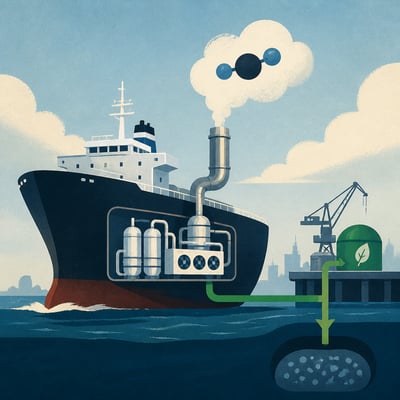
Shipping stakeholders and the IMO are moving toward a more defined framework for onboard carbon capture, with China pressing for faster guidelines, tighter reporting rules, and clearer pathways for CO2 handling. The main debate is now less about whether OCCS is relevant and more about how quickly it can be standardized, monitored, and integrated with port and shore infrastructure.

 Climate
 Privacy
 Bob Dylan
 Drones
 Data Centers
 AI Governance
 2026 Maine Senate Race