
 Climate
 Privacy
 Bob Dylan
 Drones
 Data Centers
 AI Governance
 2026 Maine Senate Race
Permafrost Thaw Reshapes Carbon Balance
Coverage from ScienceDaily, State of the Planet, and others
Articles
10
Active Days
146
The Topic
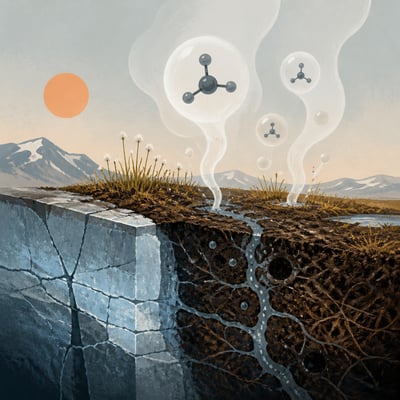
Research is refining the picture of permafrost thaw from a straightforward carbon-release process to a set of interacting biological and geological changes. Thaw can increase carbon dioxide and methane emissions by exposing stored organic matter, while also accelerating rock weathering that removes some carbon dioxide in certain river systems. The overall balance remains uncertain, with updated models suggesting northern permafrost could become a net carbon source earlier than previously projected and with several important feedbacks still incompletely represented.
First Article: 01/26/26
Latest Article: 06/20/26
Summary
- Thawing permafrost can increase the permeability of frozen ground, allowing stored carbon dioxide and methane to escape more readily.
- Updated modeling suggests northern permafrost could shift from a net carbon sink to a net source around the 2050s under high-emissions scenarios.
- Rock weathering on the Qinghai-Tibet Plateau offset about 35% of river carbon dioxide emissions on average, with larger offsets in some discontinuous-permafrost catchments.
- The carbon balance depends on interacting biological, geological, hydrological, and fire-related processes that are not fully represented in current models.
- Paleoclimate reconstructions indicate that permafrost thaw contributed substantially to atmospheric carbon dioxide increases after the last Ice Age.
- Microbial activity on glaciers can darken ice and accelerate melt, adding another pathway through which cryosphere ecosystems respond to warming.
History
The story has shifted from mainly describing permafrost as a carbon-release risk to emphasizing a more complex balance of biological emissions, geological carbon uptake, and other feedbacks. The current version also broadens the framing to say current models still incompletely represent these interacting processes.
The story now extends beyond permafrost emissions and weathering to add a new glacier-microbe pathway, while also sharpening the climate-risk case with a specific net-source timing estimate and stronger uncertainty framing in projections.
Featured
Timeline: 146 Days
Hover over any logo to see coverage summary, click for full article.