History
07/23/20260 new articles
The story has shifted from mainly describing permafrost as a carbon-release risk to emphasizing a more complex balance of biological emissions, geological carbon uptake, and other feedbacks. The current version also broadens the framing to say current models still incompletely represent these interacting processes.
07/22/20260 new articles
The story now extends beyond permafrost emissions and weathering to add a new glacier-microbe pathway, while also sharpening the climate-risk case with a specific net-source timing estimate and stronger uncertainty framing in projections.
- Permafrost regions could become net carbon sources around 2055 under high emissions.
- Cryoconite microbes darken glacier surfaces and accelerate local melt while releasing greenhouse gases.
- Weathering on the Qinghai-Tibet Plateau offsets about 35% of river CO2 emissions on average.
- Permafrost carbon losses materially contributed to post-Ice Age atmospheric CO2 increases.
- Models remain sensitive to abrupt thaw, thermokarst lakes, wildfire, vegetation, and nutrient feedbacks.
06/29/20262 new articles
The story has shifted from a broad account of permafrost-thaw carbon feedbacks to a more explicitly dual-mechanism framing: thaw both speeds greenhouse-gas escape and, in some regions, boosts rock weathering that can absorb CO2. The updated version also strengthens the paleoclimate angle by tying thaw more directly to the post-Ice Age CO2 rise and adding a clearer call for climate-model improvement.
06/18/20263 new articles
The story has broadened from a mainly emission-focused view of permafrost thaw to a fuller carbon-cycle framing that includes offsetting river weathering and a paleoclimate analogue for large-scale carbon release. It now emphasizes that thaw is a multi-mechanism climate feedback with broader geographic and mechanistic scope, though uncertainty remains high.
- River weathering on the Qinghai-Tibet Plateau can absorb some thaw-related carbon dioxide.
- Paleoclimate data suggest thawing northern soils released large carbon during deglaciation.
- Permafrost impacts now include both emissions and partial carbon sinks.
- The story now spans alpine permafrost in addition to Arctic regions.
05/17/2026Topic Formed
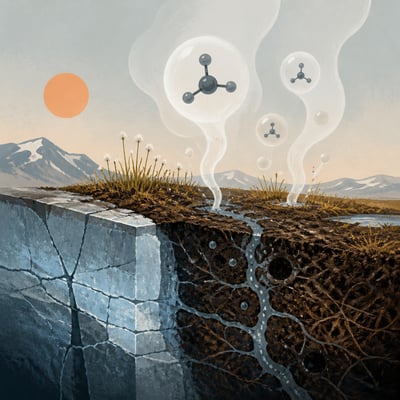
Recent research shows thawing permafrost can release greenhouse gases more easily as frozen ground becomes more permeable, microbes become more active, and plant communities shift in Arctic peatlands. The strongest signal is a warming feedback risk, but field variability and data gaps still limit precise projection.

 Climate
 Privacy
 Bob Dylan
 Drones
 Data Centers
 AI Governance
 2026 Maine Senate Race