History
07/23/20260 new articles
The story now puts more weight on mitigation details and broader adaptation, adding that rice emissions are tied to intensified management and that improved tillage and region-specific practices can reduce impacts. It also sharpens the Asia temperature-risk claim and adds India as the most affected country.
07/22/20262 new articles
The story has become more quantified and more climate-risk-focused: it now puts a concrete estimate on both past climate-driven rice losses and future temperature exposure, while also sharpening the emissions tradeoffs of adaptation. The framing shifts from general tension between climate and rice output to a more explicit policy problem of balancing yield protection with water, pollution, and methane reductions.
- Climate change cut global rice production by about 7% from 2006 to 2015.
- Asian rice regions may face much greater exposure to critical temperature thresholds by century-end.
- Flooded rice systems emitted about 1.1 billion tons CO2e annually in the 2010s.
- Intermittent irrigation and residue management can reduce emissions without necessarily lowering yields.
- Heat- and drought-tolerant rice breeding is now emphasized as a central adaptation path.
06/29/20260 new articles
The update slightly sharpens the rice-climate story by specifying that global output has continued rising despite measurable climate-driven losses, and by narrowing the main threat set toward warming, heat stress, and water shortages. It also adds named researchers and institutions behind the study, but the overall frame remains largely the same.
06/28/20263 new articles
The story broadens from a general climate-risk-and-management frame into a more explicit debate over attribution, adding a counter-thread that challenges how much climate change is driving food-price and crop-risk trends. It also strengthens the mitigation/adaptation angle by making elevated CO2 and farming practices more central to the explanation for sustained rice output.
06/17/20263 new articles
The story has broadened from a general climate-and-yield tradeoff in rice to a more specific 2026 framing that connects production risk, emissions, and concrete adaptation responses. It now adds new actors and signals that industry-facing climate-resilience messaging is becoming part of the narrative.
06/11/2026Topic Formed
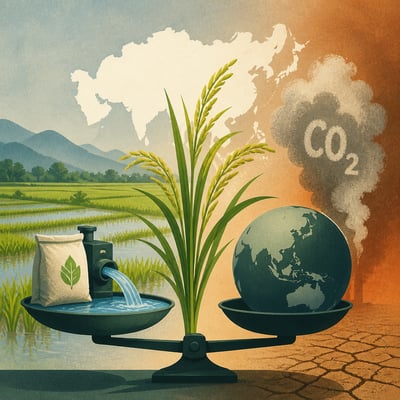
Recent material centers on how global rice production has continued to grow despite climate-related losses, largely because farmers expanded irrigation, nutrient inputs, and other management practices. At the same time, rice systems are a major source of greenhouse gas emissions, creating a tension between sustaining yields and reducing environmental impact. The topic is coherent around adaptation, emissions, and the limits of current practices across major rice-growing regions, especially Asia.

 Climate
 Privacy
 Bob Dylan
 Drones
 Data Centers
 AI Governance
 2026 Maine Senate Race