
 Climate
 Privacy
 Bob Dylan
 Drones
 Data Centers
 AI Governance
 2026 Maine Senate Race
Climate Models Understate Economic Damage
Coverage from Grantham Research Institute on Climate Change and the Environment, Net Zero Investor, and others
Articles
12
Active Days
167
The Topic
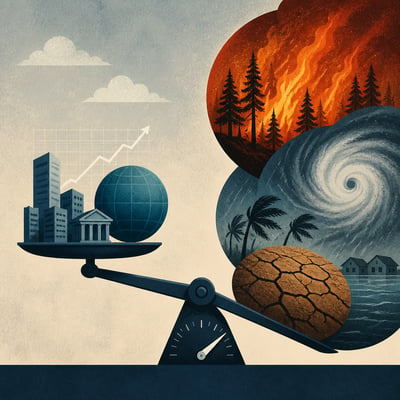
Research and investor analysis indicate that widely used climate-risk models may understate physical damages by relying on global average temperatures, GDP effects, and historical relationships that do not fully capture extreme events, tipping points, or cascading disruption. The gap matters for governments, central banks, pension funds, insurers, and asset managers because understated risks can affect capital allocation, valuations, resilience planning, and financial stability. UK-specific analysis illustrates the range of potential exposure, while broader research calls for models that include regional shocks, inequality, mortality, supply-chain effects, and low-probability high-impact outcomes.
First Article: 02/04/26
Latest Article: 07/20/26
Summary
- Mainstream models often treat climate change as a gradual, marginal shock rather than a source of structural and compounding disruption.
- Global mean temperature and GDP alone can obscure regional damage, mortality, inequality, ecosystem loss, displacement, and supply-chain effects.
- Researchers identify heatwaves, floods, droughts, sea-level rise, tropical cyclones, tipping points, and other tail risks as areas frequently underrepresented in modelling.
- A UK assessment estimates current climate damages at 1% to 4% of GDP and projects 2% to 20% by 2100 under 4°C warming, while stressing substantial uncertainty.
- Financial markets and portfolios can face losses through asset damage, business interruption, supply-chain disruption, and weaker company performance.
- Investors and policymakers are being urged to use broader scenarios, better datasets, resilience measures, and closer collaboration between climate scientists and economists.
History
The story is largely stable, but the current version reframes it more explicitly as a financial-stability and portfolio-allocation issue affecting a wider set of stakeholders. It also sharpens the modelling critique by stressing structural, compounding disruption rather than gradual GDP losses.
The story has broadened from a critique of GDP-based climate damage models into a more explicit claim that physical climate risk is already showing up in financial portfolios and could produce very large near-term losses. It also adds more concrete institutional and research actors behind the push for broader risk modeling.
Featured
Timeline: 167 Days
Hover over any logo to see coverage summary, click for full article.