History
07/23/20260 new articles
The story is largely stable, but the current version reframes it more explicitly as a financial-stability and portfolio-allocation issue affecting a wider set of stakeholders. It also sharpens the modelling critique by stressing structural, compounding disruption rather than gradual GDP losses.
07/22/20263 new articles
The story has broadened from a critique of GDP-based climate damage models into a more explicit claim that physical climate risk is already showing up in financial portfolios and could produce very large near-term losses. It also adds more concrete institutional and research actors behind the push for broader risk modeling.
- Physical climate risk is already affecting portfolios.
- UK damages are estimated at 1% to 4% of GDP today.
- Losses could reach 2% to 20% of GDP by 2100 under 4°C warming.
- $1.3 trillion in potential listed-company losses is newly estimated.
- University of Delaware researchers led by James Rising are newly identified.
06/23/20263 new articles
The story has sharpened from a broad critique of GDP-based climate models into a more UK-centered, finance-relevant debate with new quantified damage estimates and a stronger emphasis on cascading physical risks and long-run losses. The latest version also adds more explicit methodological criticism about how losses are reported.
05/30/20260 new articles
The story now frames the critique more explicitly as a financial-system issue, not just a climate-modeling one, and adds evidence that UK asset owners are already using this critique in governance discussions. It also widens the cast to regulators and asset managers, while the historical modeling background becomes a secondary thread.
05/11/2026Topic Formed
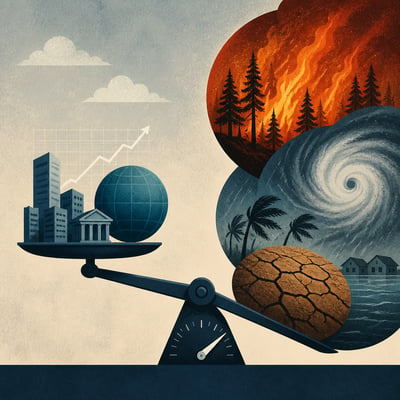
Recent coverage shows a strong push to revise climate-economic models that still treat climate damages as marginal or overly averaged. The dominant signal is that GDP-based and mean-temperature-based frameworks understate cascading physical risks, regional shocks, and tail events, with direct implications for investors, regulators, pensions, and insurance. Most of the material comes from research and industry commentary urging broader metrics, better scenario design, and closer collaboration between climate scientists and economists.

 Climate
 Privacy
 Bob Dylan
 Drones
 Data Centers
 AI Governance
 2026 Maine Senate Race