History
07/22/20260 new articles
The framing has sharpened: the story now emphasizes enforceable consent and decision-making authority, not just direct funding access, as the core failure in climate projects affecting Indigenous communities. It also adds the 2025 Green Climate Fund evaluation and broadens the geography slightly to the Arctic region while keeping the same underlying conflict.
07/22/20260 new articles
The story now places stronger emphasis on specific 2026 examples showing how renewable-energy and geoengineering-related projects can still harm Indigenous rights, not just conservation and carbon-market conflicts. It also adds a concrete court-backed land-rights context in Kenya and a new U.S. sacred-site case involving the Yakama Nation.
07/22/20260 new articles
The story is now more specific and evidence-backed: it quantifies how little climate finance reaches Indigenous and local communities and adds concrete cases showing how climate projects can threaten land rights, sacred sites, and consent. The framing also broadens from general exclusion to a sharper focus on direct funding, enforceable consent, and land-use choices that reduce conflict.
- Less than 1% of global climate funding reached Indigenous and local communities, 2011–2020.
- Green Climate Fund criticized for no direct Indigenous organization accreditation.
- Ogiek people face eviction pressure in Kenya’s Mau Forest.
- Geoengineering proposals now included among contested climate projects.
- Already disturbed land proposed as a conflict-reducing siting option.
06/16/2026Topic Formed
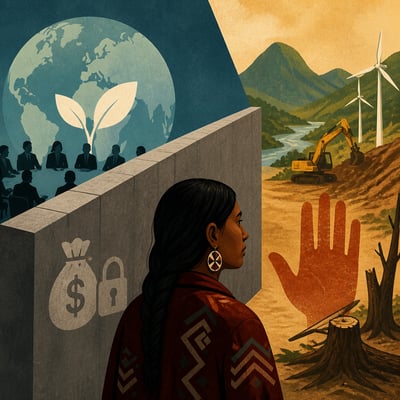
The material centers on a persistent mismatch between climate rhetoric and practice: Indigenous peoples are often described as essential stewards of nature but remain underfunded and excluded from climate decisions. Reports highlight weak access to climate finance, limited tracking of money reaching Indigenous communities, and repeated conflicts over land-based climate projects. The topic also includes broader concerns about consent, land rights, and whether climate solutions can be implemented without repeating displacement and consultation failures.

 Climate
 Privacy
 Bob Dylan
 Drones
 Data Centers
 AI Governance
 2026 Maine Senate Race