
 Climate
 Privacy
 Bob Dylan
 Drones
 Data Centers
 AI Governance
 2026 Maine Senate Race
Scientists Retire Worst-Case Climate Scenario
Coverage from The Washington Post, The Conversation, and others
Articles
21
Active Days
76
The Topic
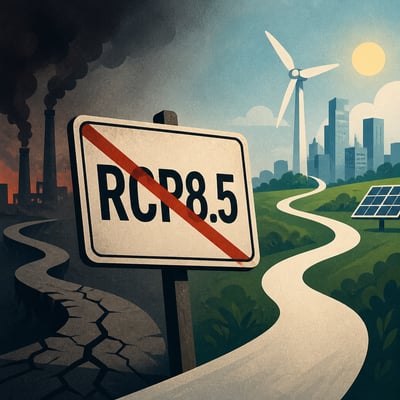
International climate researchers are retiring RCP8.5 and its successor SSP5-8.5 from updated scenario sets because rapid growth in solar, wind, electric vehicles and batteries, along with climate policies, has reduced the plausibility of their extreme fossil-fuel assumptions. The change does not indicate that climate risks have been resolved: emissions remain high, the most optimistic pathways still imply some overshoot of 1.5°C, and current-policy pathways continue to point to substantial warming. The update also renews debate over how high-emissions scenarios should be used in research, public communication and policy.
First Article: 05/14/26
Latest Article: 07/28/26
Summary
- RCP8.5 and SSP5-8.5 are being removed from updated climate scenario sets because their assumed surge in fossil-fuel use is no longer considered plausible by many researchers.
- Growth in solar, wind, electric vehicles and batteries, alongside climate policy, has slowed projected emissions growth but has not yet produced sustained global emissions declines.
- The retirement of the worst-case pathway does not invalidate earlier climate modeling or mean that climate impacts are becoming less severe.
- Updated pathways still include roughly 3.5°C or more of warming under high-emissions conditions, while the most optimistic paths generally involve a temporary breach of 1.5°C.
- The material presents current policies as falling between the most and least emissions-intensive pathways, leaving outcomes highly dependent on future policy and technology choices.
- A minority or advocacy-oriented strand of the discussion argues that RCP8.5 was widely misused as a likely forecast and influenced policy beyond its intended scenario role.
History
The update strengthens the case for retiring RCP8.5 by tying it more explicitly to observed clean-energy growth and policy effects, while adding a sharper debate over how the scenario was used in research and public discourse. It also broadens the framing from simple scenario replacement to an ongoing argument about scenario misuse and communication.
The story has shifted from a narrower climate-scenario update to a broader methodological and policy-relevance debate. Beyond retiring the extreme pathway, the new version emphasizes how scenario changes affect stress tests, litigation, and public interpretation.
Featured
Timeline: 76 Days
Hover over any logo to see coverage summary, click for full article.