
Last Update: 08/01/2026 at 5:00 PM EST

Soil Restoration for Climate Resilience

Coverage from 8am.media, Frontiers, and others

Articles

6

Active Days

103

The Topic
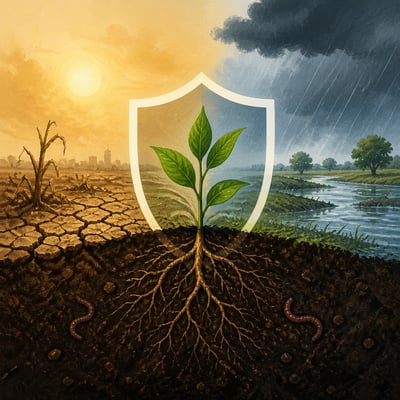
Soil Restoration for Climate Resilience topic image

Climate change, land clearing, intensive farming, deforestation, and weak land management are degrading soils and reducing their ability to support crops, retain water, and store carbon. The effects are especially acute in vulnerable agricultural regions, including Afghanistan and rain-fed farming areas, where erosion, drought, floods, and irregular rainfall threaten food security. The material increasingly frames soil restoration, regenerative agriculture, and integrated soil-security policies as practical adaptation measures, while noting that implementation requires public investment and support for farmers.

First Article: 03/24/26

Latest Article: 07/04/26

History

07/22/20260 new articles

The story is reframed from general soil degradation and restoration to a more explicit soil-security agenda that broadens the problem beyond physical land condition to institutional, social, and finance constraints. It also adds stronger emphasis on vulnerable communities’ access gaps and on floods, droughts, and dust storms as part of Afghanistan’s worsening erosion picture.

07/22/20260 new articles

The story is now framed more explicitly as an implementation problem: soil restoration is still the answer, but the current version adds that it needs investment, policy support, and transition help for farmers. It also sharpens the Afghanistan angle by tying erosion more directly to vegetation loss, deforestation, and irregular rainfall.

07/22/20262 new articles

The story broadens from a general climate-resilience case for soil health into a more concrete adaptation narrative anchored by Afghanistan and other vulnerable rural communities. It also adds stronger emphasis on land-use drivers like deforestation and vegetation loss, while keeping the core policy prescription intact.

06/05/2026Topic Formed

The material converges on soil health as a practical climate resilience strategy, not just an agricultural concern. Across the sources, degraded soils are linked to weaker carbon storage, poorer water retention, higher flood and drought risk, and worsening food-system stress. The dominant policy thread is that regenerative farming, soil restoration, and land-management reform need stronger public support if they are to scale beyond isolated practice.